If you're having trouble viewing this email, you cansee it online.
Teach About Imperialism
to Understand Venezuela
Imperialism. When one nation bullies and attempts to rule another. From the American colonies’ wars against Indigenous nations, to the occupation of Haiti (1915–1934), to the U.S.-engineered coups in Iran (1953) and Guatemala (1954), right up to this weekend’s kidnapping of the leader of Venezuela and Trump’s declaration that “We will run the country,” it has been part of this nation’s DNA. When young people learn a people’s history, they learn the legacy of imperialism — as well as organized resistance.
As we equip students to understand the immoral and illegal U.S. intervention in Venezuela, let’s frame these actions in terms of the much longer history of U.S. efforts to control other people’s lives and resources. Here, we highlight a few teaching resources.
The dominant periodization of U.S. history — in most textbooks and curricula — would have us learn something called “Westward Expansion,” separately from “U.S. Imperialism,” separately from “The Cold War.” In reality, these are better understood as a continuum. The political, economic, racial, and religious rationales used to justify the theft of Native land on this continent were the very same trotted out in 1893 and 1898 to steal the faraway lands of Hawaii, the Philippines, Puerto Rico, and Guam.
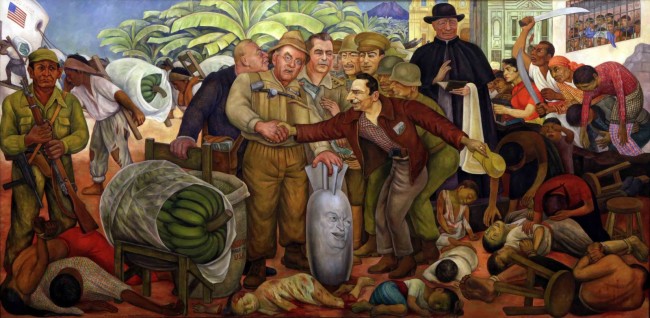
The same insatiable greed for resources that led U.S. sugar barons to overthrow Queen Lili‘uokalani also fueled United Fruit’s seizure of land across Central America and its collaboration with the CIA to install business-friendly regimes there. U.S. imperialism cannot be neatly periodized; it is not an era to be bounded by the pages of a chapter. As long as the drive for profits remains paramount to U.S. foreign policy, imperialism will be central to the very existence of the United States.
And by failing to teach the Cold War as imperialism, we also miss an opportunity to highlight the resistance that was at its heart.
With sadness, we share the news that Michael Charney suffered a heart attack and died on January 2. Charney was a passionate educator, political strategist, and labor organizer, committed to ensuring that students and the broader community learn the truth about U.S. history and have a voice in their own education.
Charney, and his wife C. J. Prentiss (who died in 2024), played a big role in the work of the Zinn Education Project for many years.
Add these events, hosted by the Zinn Education Project and our colleagues, to your 2026 calendar. Online unless noted otherwise.
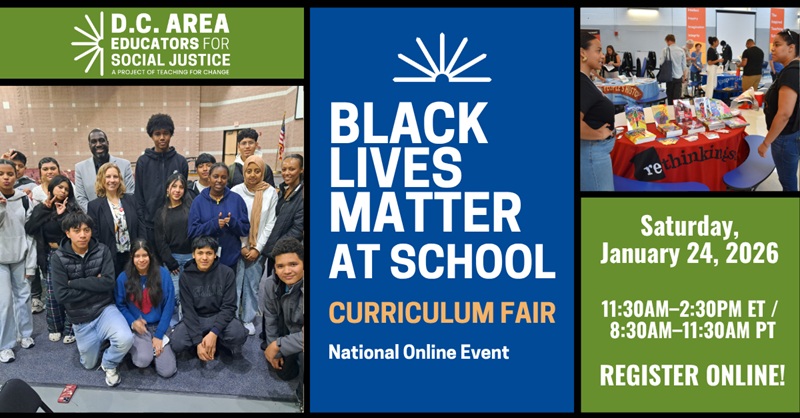
2026 Black Lives Matter at School Curriculum Fair, January 24. Workshops include: “Archives in Class: Teaching with the Emergency Committee on the Transportation Crisis Records” and “Justice in Action: Equipping Students to Reimagine Democracy.”
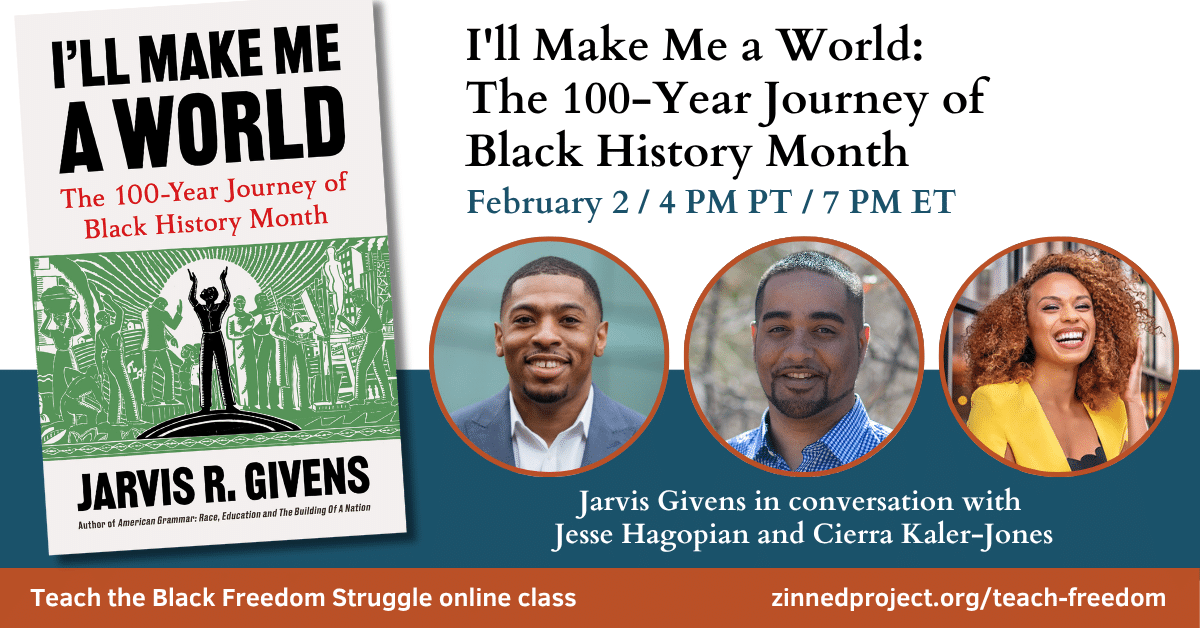
I’ll Make Me a World: The 100-Year Journey of Black History Month with Jarvis Givens, February 2. Drawing on archival research, personal stories involving family and students, and especially the wisdom of Black educators, Givens recovers the legacy of Carter G. Woodson and many others who envisioned Black history as a liberatory force — knowledge that shapes who we are, how we resist, and what we dream.
The annualNative Knowledge 360° Teach-In, hosted by the Smithsonian’s National Museum of the American Indian in collaboration with Teaching for Change on March 14, is an online opportunity for educators to access classroom resources from NMAI’s Native Knowledge 360° education portal, the Zinn Education Project, and more.
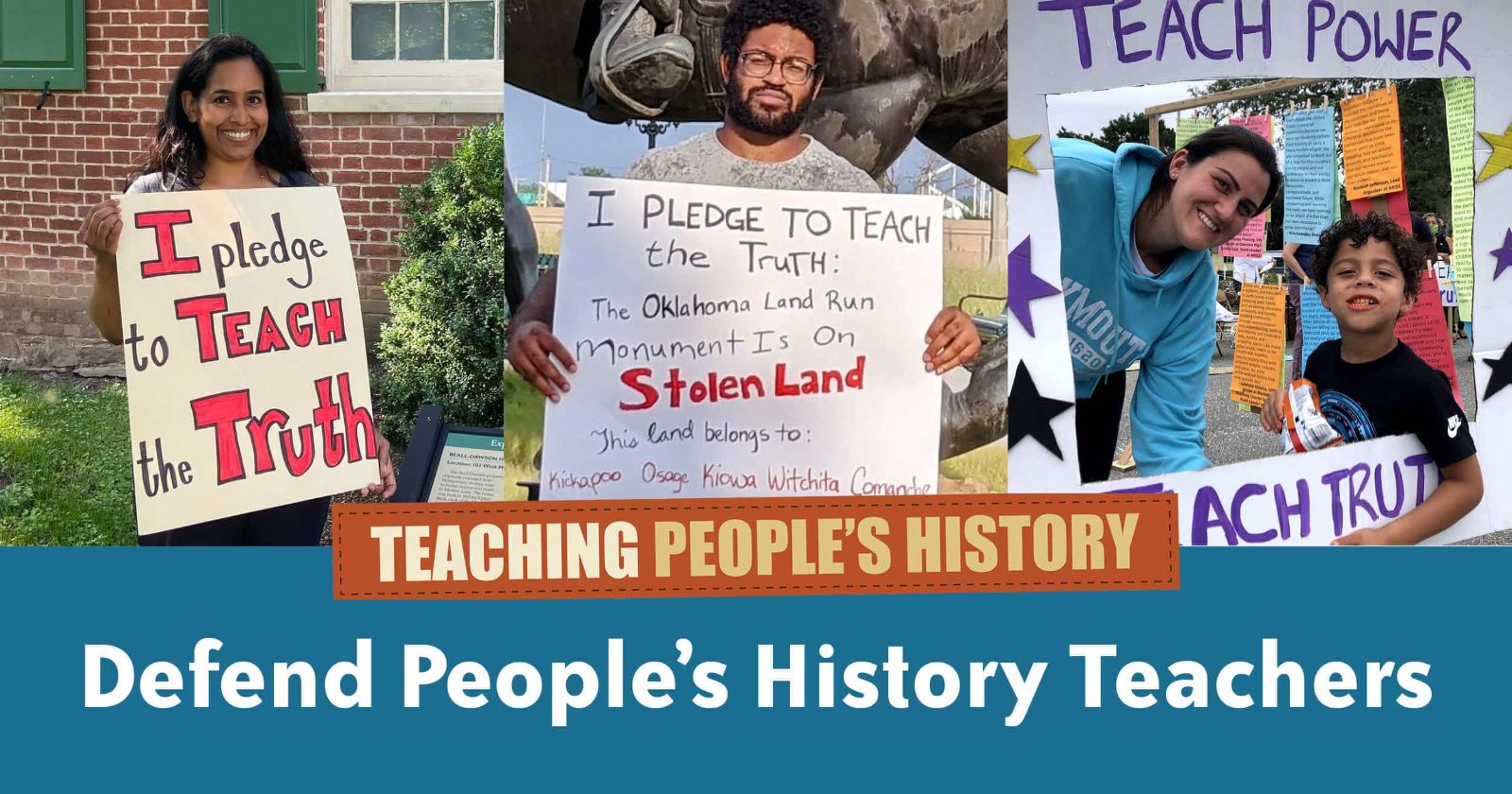
Teachers are under attack for teaching truthfully about U.S. history. Please donate so we can continue to offer free people’s history lessons and resources, and defend teachers’ right to use them.